The first ABM platform built for missions, not just leads.
SpaceGTM turns first-party behavior into service-lane intent + mission constraints, then outputs a procurement-ready brief your team can route to quotes, scheduling, and fulfillable capacity.
Less vendor glue code. Less brittle customization. Built to close space services deals — not just run campaigns.
Horizontal ABM tools weren't built for space procurement.
Tools like 6sense and Demandbase are generic "intent + ads + orchestration" layers. But in space, the unit of work isn't a marketing lead — it's a mission-driven procurement request with constraints: interfaces, orbit regimes, lead times, compliance gates, capacity windows, and multi-leg service chains.
You can bolt space fields onto a marketing funnel… but you still force space reality through a lead-shaped workflow.
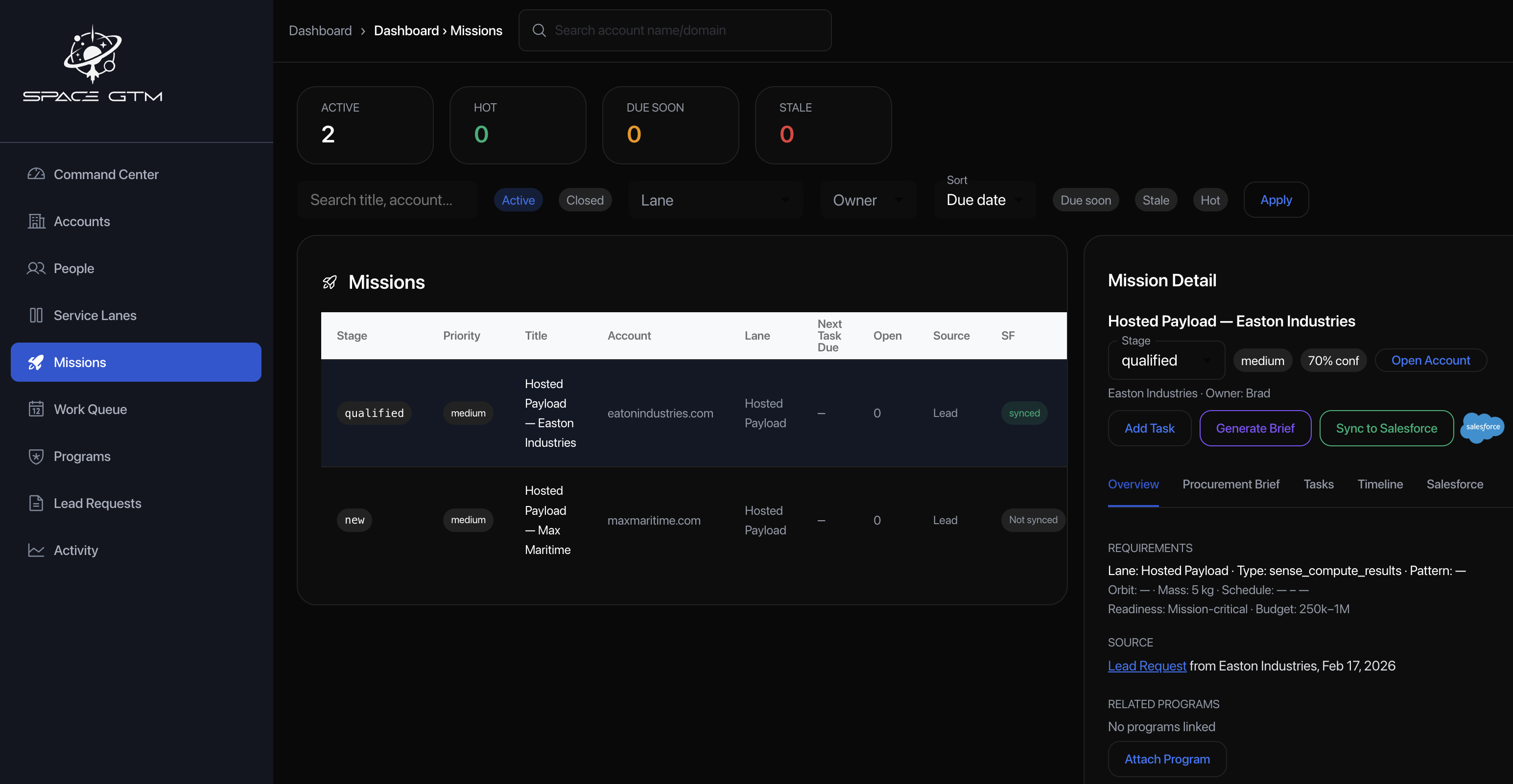
SpaceGTM starts where those platforms stop.
SpaceGTM captures intent as prospects explore service lanes, then generates procurement-grade briefs and orchestrates next steps all the way to quotes, scheduling, and routing to fulfillable capacity — with explainable "why this is hot" logic (not a black-box score).
Procurement brief (quote-grade)
Explainable intent trail (why now)
Mission object to track from first signal → reservation
Every interaction becomes an auditable sales artifact.
Turn anonymous interest and reservation requests into auditable artifacts, explainable intent, and ranked accounts — so Sales and Ops work from the same canonical record.
Lead Request (canonical artifact)
Every submission is stored as a Lead Request — the auditable sales artifact you can route and revisit.
Procurement Brief (quote-grade output)
Structured requirements, schedule window, readiness, budget band, org + contact — ready for quoting.
Intent Signals (explainable heat)
A time-series trail that shows exactly why an account is heating up — not just a score.
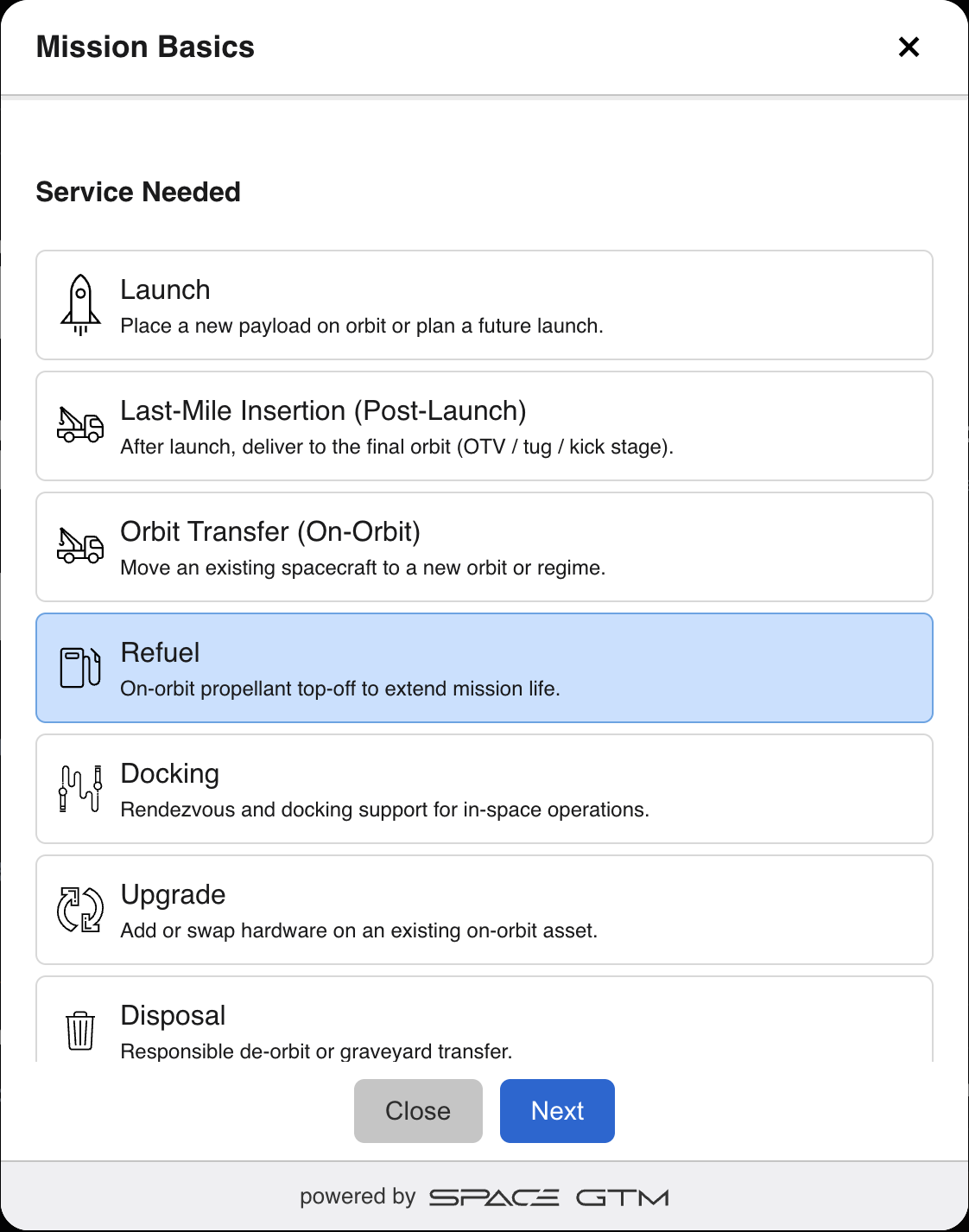
The widget that produces a procurement brief.
Not a "contact us" form — a progressive Request a Reservation flow that adapts to the selected service lane and only asks what matters.
Progressive qualification: Step-by-step questions adapt to the selected service lane so you only ask what matters.
Procurement Brief output: Every submission becomes a structured, auditable brief (requirements, schedule, readiness, budget band, contact + org).
Instant routing + prioritization: The backend scores each submission and assigns it to the right lane/owner without manual triage.
No lost context: The brief stays linked to the Account and Person, so sales + ops see the same canonical artifact.
Built for "quote-ready" deals: Captures the details vendors need to respond fast (not a generic marketing lead).
How it works.
From first-party intent → procurement brief → qualification → routing → sales/ops execution1
Capture mission intent
Prospects explore service lanes and submit a Request a Reservation (progressive questions that adapt by lane).
2
Create the Lead Request (canonical artifact)
Every submission is stored as a Lead Request — the auditable record that anchors the opportunity.
3
Resolve Account + Person
We link the request to a Prospect Company + Contact so sales and ops work from the same account context.
4
Build Intent Signals (explainable evidence)
We write time-series Intent Signals that show why this is hot (not just a black-box score).
5
Score continuously
Lead score per request + rolling 30-day account intent with decay/normalization.
6
Generate a procurement-ready brief (AI + rules)
We convert the Lead Request + signals into a procurement brief with:
- Mission intent (what outcome they're buying)
- Constraints (orbit bands, interfaces, comms, power/thermal assumptions, timeline)
- Assumptions (explicit defaults when info is incomplete)
- Missing fields (what's required to quote / schedule)
7
Run a lane-specific qualification workflow (internal)
Each lane has required fields and gates (quote-ready standard):
- Required fields by lane (orbit, interfaces, bands, timeline, compliance)
- "What's missing" checklist + confidence level
- Compliance gates (export/control constraints, end user, licensing)
8
Route using a rules engine
Deterministic routing based on constraints and capacity:
- Lane → provider pool → assignment (human + automated)
- Includes fallback routing if the preferred path can't accept the job.
9
Execute through a Sales/Ops work queue
Every qualified request becomes a managed work item:
- Owners, status, next-best-action
- SLA timers + escalation
- Full audit trail across handoffs
10
Create / update a Salesforce Opportunity (system of record sync)
When a Lead Request becomes Qualified (quote-ready), SpaceGTM syncs it to Salesforce or HubSpot:
- Upsert Account + Contact (if needed)
- Create Opportunity (or attach to an open one)
- Attach the Procurement Brief + key constraints as fields
- Set stage + owner + SLA + next action


End-to-end, SpaceGTM takes you from first-party intent to a procurement-ready, qualified, routed work item—and syncs it into Salesforce as a ready-to-run Opportunity.
Intent Tracking + Identity Resolution
First-party intent tracking (anonymous → known)
SpaceGTM captures first-party intent across your site using tracking tools like PostHog and Marketo. We track anonymous visitors, record their service-lane behavior over time, and when they submit a request—or we identify them via your systems—we link that history to a known person and account.
So sales sees the full "why now" timeline for every opportunity—before the first call.


THE DEAL OBJECT
Mission workspaces.
Demandbase/6sense can tell you who is showing intent. SpaceGTM tells you what they're trying to fly — and tracks it as a Mission from first signal to reservation.
Mission Workspaces: Convert anonymous intent + lead requests into a structured “program” object with lane, orbit, schedule window, readiness, and budget band.
Evidence-backed “Why now”: Every score is explainable — signals, weights, and timelines tied to the Mission.
Procurement-grade briefs: Capture quote-ready requirements (interfaces, mass/power, timeline, ops model) and route to the right operators.
Built for multi-leg outcomes: Launch + mobility + hosting + ground + return — track the package, not just the account.
REVENUE LIFECYCLE
From procurement brief to committed mission.
In space, deals don't move through generic CRM stages — they move through requirements, readiness gates, and schedule windows. SpaceGTM turns every qualified request into an executable opportunity with owners, due dates, and an audit trail:
interest → qualified brief → routed providers → committed schedule → closed revenue
You're not buying a lead.
You’re buying a quote-grade opportunity + account intent + proof trail.
Qualified Opportunity Feed (the brief)
Structured procurement brief + metadata
Route/page, readiness score, routing tags
Compliance posture flags for filtering
MOST POPULAR
Account Context (SpaceGTM portal)
Account + domain, intent level (H/M/L)
Evidence: pages, widget steps, fields
Buying committee signals + changes over time
Proof Pack (why it's real)
One-page "evidence timeline" per opportunity
Shows progression: pricing → config → submit
What changed: budget/timeline/readiness upgrades
The biggest quality drivers are brief completeness, verification (domain + role), and evidence depth.